.svg)

























Frequently Asked Questions
Attanda operates on a value-based engineering model. We typically begin with a fixed-fee Strategic Audit to map your architecture and define ROI. For the full implementation, we structure contracts as a Project Fee (for the build and deployment) followed by a monthly Orchestration Retainer (for maintenance, model updates, and scaling). Since every Sovereign AI architecture is custom-engineered to your stack, we provide a precise quote only after the initial audit.
No. We utilise a "Shadow Mode" deployment strategy. We build, train, and test your new AI architecture in a parallel, isolated environment that mirrors your live data but does not touch your active operations. We only switch the system to "Live" (Production) once it has achieved 99.9% stability and your team has been fully trained, ensuring zero downtime and no disruption to your daily business.
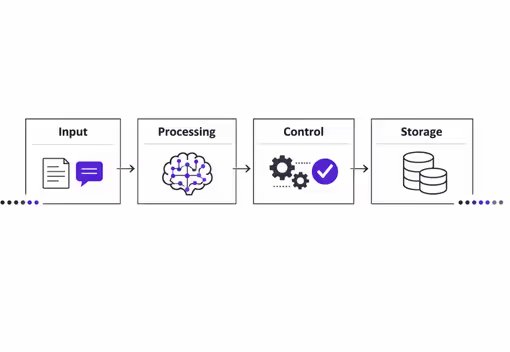
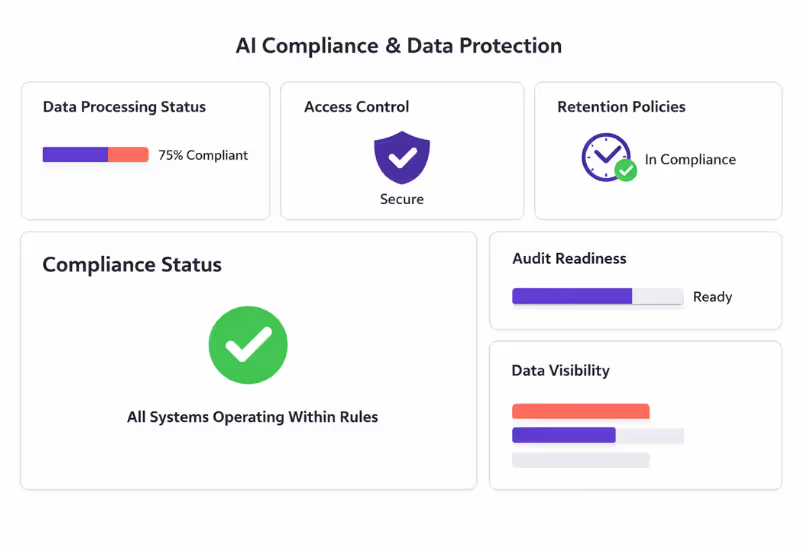
We do not rely on public, "black-box" models for sensitive data. We engineer Sovereign AI environments. This means your data is processed on EU-based infrastructure (or on-premise if required) using enterprise-grade encryption. We configure local LLMs and vector databases that allow the AI to learn from your data without ever training external public models, ensuring full compliance with Austrian and EU data privacy laws (DSGVO).
Yes. Our architecture is agnostic. We build custom API layers and "Middleware" that act as a bridge between our AI agents and your existing tools (whether that is SAP, Salesforce, HubSpot, or a custom legacy SQL database). The AI acts as an orchestration layer, pulling data from and pushing actions to your existing software, so you do not need to replace your current tech stack.
AI is powerful, but dangerous if misaligned. The Strategic Audit is our diagnostic phase. It allows us to mathematically identify where automation will yield the highest ROI before you commit to a large capital expenditure. In this phase, we map your "Data Hygiene," identify bottlenecks, and produce an architectural blueprint. This ensures that when we do build, we are solving the right problem, not just adding technology for technology's sake.